
Negative impact of the combination of acute myocardial infarction with active COVID-19 and wartime-associated factors on the course of the long-term post-infarction period
Article Sidebar

This work is licensed under a Creative Commons Attribution-ShareAlike 4.0 International License.
Main Article Content
 https://orcid.org/0000-0002-1427-2344
Abstract
The aim – to identify markers of long-term cardiovascular risk in patients with acute myocardial infarction (AMI) with concomitant active COVID-19 and in patients with AMI during wartime, and to evaluate the impact of these factors on the course of the post-infarction period.
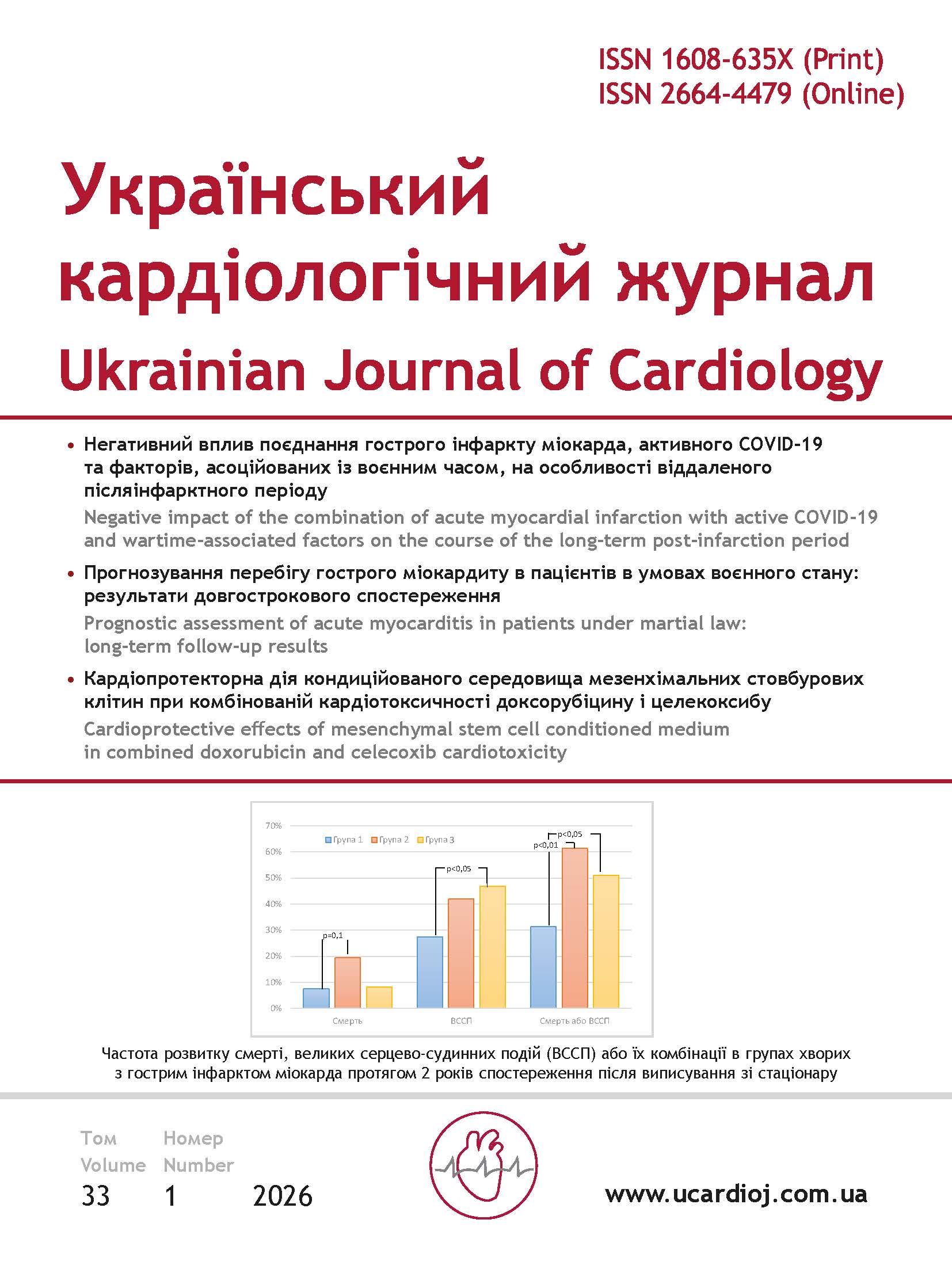
Materials and methods. A cohort of 160 patients with AMI was examined (mean age 64 years; 78 % men). The first group (n=80) was treated before the COVID-19 pandemic and served as a control group. The second group (n=31) was treated during the pandemic with active concomitant SARS-CoV-2 infection. The third group (n=49) was treated during wartime in Ukraine and had no active COVID-19 infection. All patients received standard in-hospital treatment according to current guidelines with appropriate clinical and laboratory evaluation. Patients who died during hospitalization were excluded. All enrolled patients underwent a 2-year follow-up. Outcomes included all-cause mortality, major cardiovascular events, and a composite endpoint of death or cardiovascular events.
Results and discussion. Patients with concomitant COVID-19 demonstrated a higher rate of long-term mortality (19.4 % vs 7.5 % in controls, p=0.1), whereas patients with AMI during wartime had the highest rate of nonfatal cardiovascular events (46.9 % vs 27.5 % in controls, p<0.05). Significant markers of long-term cardiovascular risk in AMI patients with COVID-19 included the lymphocyte percentage (> 15 % on day 1 of AMI and > 18 % on days 5–10), as well as a composite scale incorporating in-hospital lymphocyte percentages, total bilirubin, and HDL cholesterol measured on day 1 (sensitivity 91.7 %, specificity 87.5 %, p<0.001). In wartime AMI patients, long-term risk was predicted by a scale including leukocyte count, hemoglobin level and platelet inhomogeneity percentage by size on day 1, lymphocyte percentage and glucose level on days 5–10, as well as coronary stenting, in-hospital ticagrelor therapy, and the presence of > 2 significant (> 70 %) or > 3 total coronary stenoses (sensitivity 76.2 %, specificity 95 %, p<0.001).
Conclusions. In AMI patients, concomitant COVID-19 is associated with increased long-term mortality, while wartime factors increase long-term risk primarily through nonfatal cardiovascular events. These effects on the post-infarction period are linked to maladaptive inflammatory and stress responses to myocardial injury, reflected in specific clinical and laboratory changes. Unlike the previously widely used neutrophil-to-lymphocyte ratio, these markers allow individualized assessment of long-term cardiovascular risk in these patients.
Article Details
Keywords:
References
Aikawa T, Takagi H, Ishikawa K, Kuno T. Myocardial injury characterized by elevated cardiac troponin and in-hospital mortality of COVID-19: an insight from a meta-analysis. J Med Virol. 2021;93:51-5. https://doi.org/10.1002/jmv.26108
Alle S, Kanakan A, Siddiqui S, Garg A, Karthikeyan A, Mehta P, Mishra N, Chattopadhyay P, Devi P, Waghdhare S, Tyagi A, Tarai B, Hazarik PP, Das P, Budhiraja S, Nangia V, Dewan A, Sethuraman R, Subramanian C, Srivastava M, Chakravarthi A, Jacob J, Namagiri M, Konala V, Dash D, Sethi T, Jha S, Agrawal A, Pandey R, Vinod PK, Priyakumar UD. COVID-19 Risk Stratification and Mortality Prediction in Hospitalized Indian Patients: Harnessing clinical data for public health benefits. PLoS One. 2022 Mar 17;17(3):e0264785. https://doi.org/10.1371/journal.pone.0264785
Bains JS, Sharkey KA. Stress and immunity – the circuit makes the difference. Nat Immunol. 2022;23:1137-9. https://doi.org/10.1038/s41590-022-01276-1
Bilovol OM, Knyazkova II, Barbashova VO, Kirienko OM, Podpryadova AV. Analysis of prevalence and incidence of arterial hypertension in a frontline city. Ukrainian J Cardiol. 2025;32(Suppl 1):79. Ukrainian. https://ucardioj.com.ua/index.php/UJC/issue/view/74/pdf
Bonaventura A, Vecchié A, Dagna L, et al. Endothelial dysfunction and immunothrombosis as key pathogenic mechanisms in COVID-19. Nat Rev Immunol. 2021;21(5):319-29. https://doi.org/10.1038/s41577-021-00536-9
Cascella M, Rajnik M, Aleem A, Dulebohn SC, Di Napoli R. Features, Evaluation, and Treatment of Coronavirus (COVID-19). 2022 May 4. In: StatPearls [Internet]. Treasure Island (FL): StatPearls Publishing; 2022 Jan. PMID: 32150360
Garcia M, Moazzami K, Almuwaqqat Z, Young A, Okoh A, Shah AJ, Sullivan S, Lewis TT, Elon L, Ko YA, Hu Y, Daaboul O, Haddad G, Pearce BD, Bremner JD, Sun YV, Razavi AC, Raggi P, Quyyumi AA, Vaccarino V. Psychological Distress and the Risk of Adverse Cardiovascular Outcomes in Patients With Coronary Heart Disease. JACC Adv. 2024;3(2):100794. https://doi.org/10.1016/j.jacadv.2023.100794
Hausenloy DJ, Yellon DM. Myocardial ischemia-reperfusion injury: a neglected therapeutic target. J Clin Invest. 2013;123(1):92-100. https://doi.org/10.1172/JCI62874
Hilser JR, Spencer NJ, Afshari K, Gilliland FD, Hu H, Deb A, Lusis AJ, Tang WHW, Hartiala JA, Hazen SL, Allayee H. COVID-19 is a coronary artery disease risk equivalent and exhibits a genetic interaction with ABO blood type. Arterioscler Thromb Vasc Biol. 2024 Nov;44(11):2321-33. https://doi.org/10.1161/ATVBAHA.124.321001
Hovornian AV, Ilashchuk TO. Long-term cardiovascular complications after COVID-19: the role of biomarkers and prognostic models. Ukrainian J Cardiol. 2025;32(Suppl 1):6. Ukrainian. https://ucardioj.com.ua/index.php/UJC/issue/view/74/pdf
Institute for Health Metrics and Evaluation: GBD Compare. Ukraine. Both sexes. All ages. 2023. Deaths. http://ihmeuw.org/7ei2
Kovnick MO, Young Y, Tran N, Teerawichitchainan B, Tran TK, Korinek K. The Impact of Early Life War Exposure on Mental Health among Older Adults in Northern and Central Vietnam. J Health Soc Behav. 2021;62(4):526-44. https://doi.org/10.1177/00221465211039239
Lutay MI, Holikova IP, Bugaienko VV, Shvydka MP. Features of coronary artery disease course in internally displaced persons under martial law conditions. Ukrainian J Cardiol. 2025;32(Suppl 1):20-1. Ukrainian. https://ucardioj.com.ua/index.php/UJC/issue/view/74/pdf
Nanavaty D, Sinha R, Kaul D, Sanghvi A, Kumar V, Vachhani B, Singh S, Devarakonda P, Reddy S, Verghese D. Impact of COVID-19 on Acute Myocardial Infarction: A National Inpatient Sample Analysis. Curr Probl Cardiol. 2024 Jan;49(1 Pt A):102030. https://doi.org/10.1016/j.cpcardiol.2023.102030
Nishiura H, Kobayashi T, Miyama T, Suzuki A, Jung SM, Hayashi K, Kinoshita R, Yang Y, Yuan B, Akhmetzhanov AR, Linton NM. Estimation of the asymptomatic ratio of novel coronavirus infections (COVID-19). Int J Infect Dis. 2020 May;94:154-5. https://doi.org/10.1016/j.ijid.2020.03.020
Onder G, Rezza G, Brusaferro S. Case-fatality rate and characteristics of patients dying in relation to COVID-19 in Italy. JAMA. 2020;323(18):1775-6. https://doi.org/10.1001/jama.2020.4683
Palmblad J, Karlsson CG, Levi L, Lidberg L. The erythrocyte sedimentation rate and stress. ActaMedScand. 1979;205(6):517-20. https://doi.org/10.1111/j.0954-6820.1979.tb06094.x
Poluzzi E, Raschi E, Motola D, Moretti U, De Ponti F. Antimicrobials and the risk of torsades de pointes: the contribution from data mining of the US FDA Adverse Event Reporting System. Drug Saf 2010;33(4):303-14. https://doi.org/10.2165/11531850-000000000-00000
Roohafza H, Talaei M, Sadeghi M, Mackie M, Sarafzadegan N. Association between acute and chronic life events on acute coronary syndrome: a case-control study. J Cardiovasc Nurs. 2010;25(5):E1-7. https://doi.org/10.1097/JCN.0b013e3181d81799
Rus M, Ardelean AI, Andronie-Cioara FL, Filimon GC. Acute Myocardial Infarction during the COVID-19 Pandemic: Long-Term Outcomes and Prognosis –A Systematic Review. Life 2024 Jan 31;14(2):202. https://doi.org/10.3390/life14020202
Schneider M, Kraemmer MM, Weber B, Schwerdtfeger AR. Life events are associated with elevated heart rate and reduced heart complexity to acute psychological stress. Biol Psychol. 2021 Jul;163:108116. https://doi.org/10.1016/j.biopsycho.2021.108116
White AG, Elias E, Orozco A, Robinson SA, Manners MT. Chronic Stress-Induced Neuroinflammation: Relevance of Rodent Models to Human Disease. International Journal of Molecular Sciences. 2024;25(10):5085. https://doi.org/10.3390/ijms25105085